





































The Netis P106C is a reliable and efficient 6-port Ethernet switch designed to meet the demands of modern network setups. With 4 Power over Ethernet (PoE) ports providing both data and power, along with 2 standard RJ45 uplink ports, this switch is a versatile solution for various networking needs. Adhering to IEEE 802.3 and IEEE 802.3u standards for Ethernet and Fast Ethernet protocols, the P106C ensures seamless compatibility with a wide range of network devices. It supports IEEE 802.3af/at compliant Powered Devices (PD), making it suitable for devices such as IP cameras, access points, and more. The switch employs a store-and-forward switching scheme, providing reliable data transmission. It supports IEEE 802.3X full duplex and Backpressure half duplex, enhancing network efficiency. The MAC address auto-learning and auto-aging features contribute to efficient network management. Operating in both normal switch mode and extended mode, the P106C offers flexibility based on specific network requirements. The data transfer rate is optimized for different Ethernet types, with speeds of 10Mbps or 20Mbps in half-duplex and 100Mbps or 200Mbps in full-duplex. With a switching capacity of 1.2G and a MAC address table size of 2K, the switch ensures sufficient bandwidth for data-intensive applications. It supports Jumbo Frames up to 2048 bytes, further enhancing data transfer efficiency. The switch is equipped with over-current, over-voltage, and short-circuit protection for enhanced safety and durability. The Soft Start feature for high-power PD prevents power surges during startup. With sequential boot-up support, the switch ensures a smooth and stable power-on sequence. Operating in a temperature range of 0℃ to 40℃ and a storage temperature range of -40℃ to 70℃, the P106C is suitable for various environments. The humidity tolerance, ranging from 10% to 90% RH for operation and 5% to 90% RH for storage, further expands its versatility. With a maximum power supply of 58W and support for AC 110-240V 50/60Hz input, the P106C is a reliable and power-efficient networking solution. Its compact dimensions (124mm*115mm*33mm) make it suitable for desktop or wall-mounted installations, ensuring a space-efficient and organized network setup.
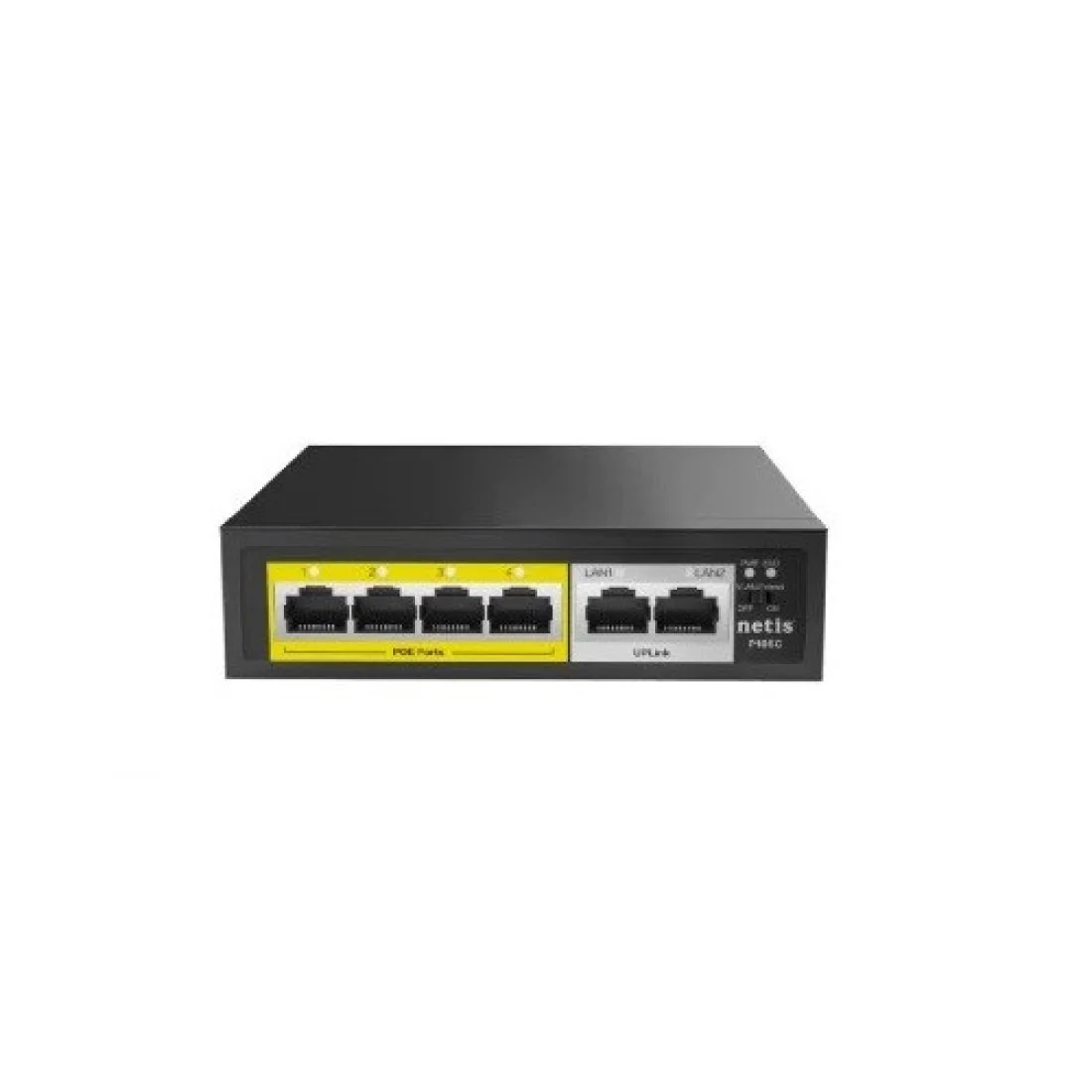
Netis P106C 4POE 2RJ45 100M Standard POE Switch
| Hardware | |
| Interface | 4*10/100Mbps POE ports(Data/Power)2*10/100M uplink RJ45 ports (Data) |
|
Basic function
|
Follow IEEE 802.3 Ethernet and IEEE802.3u Fast Ethernet Protocol
Supports POE IEEE 802. 3af/at compliant Powered Device (PD)
Store-and-forward switching scheme |
|
Standards
|
IEEE 802.3 10BASE-T Ethernet
IEEE 802.3i 10BASE-T Ethernet
IEEE 802.3u 100BASE-TX Fast Ethernet |
|
Mode
|
Normal switch mode/Extend mode
|
|
Data Transfer Rate
|
Etherent:10Mbps(Half-duplex);20Mbps(Full-duplex)Fast Entherent:100Mbps(Half-duplex);200Mbps(Full-duplex) |
|
Store & Forwarding
|
Yes |
|
Switching Capacity
|
1.2G |
|
MAC Address
Table Size
|
2K |
|
Jumbo Frame
|
2048 byte
|
|
Environment
|
Operation Temperature:0℃~40℃
Storage Temperature:-40℃~70℃
Operation Humidity:10%~90% RH Non-condensing
Storage Humidity:5%~90% RH Non-condensing
|
|
Power Input POE
Standards
|
Single port maximum power 30W,
Whole switch maximum power 58W Support over-current,over-voltage and short-circuit protection Support Soft Start of High Power PD Support sequential boot-up
Power Supply Pin:12+/36-
AC 110~240V 50/60HZ
|
|
Cabling type
|
100Base-TX: Cat 5e or better UTP/STP(≤100m)
10Base-TX: Cat 5e or better UTP/STP(≤250m)
|
|
Dimensions
(L x W x H )
|
124mm*115mm*33mm
|
3,200.00৳
Product Description
Netis P106C 4POE 2RJ45 100M Standard POE Switch
| Hardware | |
| Interface | 4*10/100Mbps POE ports(Data/Power)2*10/100M uplink RJ45 ports (Data) |
|
Basic function
|
Follow IEEE 802.3 Ethernet and IEEE802.3u Fast Ethernet Protocol
Supports POE IEEE 802. 3af/at compliant Powered Device (PD)
Store-and-forward switching scheme |
|
Standards
|
IEEE 802.3 10BASE-T Ethernet
IEEE 802.3i 10BASE-T Ethernet
IEEE 802.3u 100BASE-TX Fast Ethernet |
|
Mode
|
Normal switch mode/Extend mode
|
|
Data Transfer Rate
|
Etherent:10Mbps(Half-duplex);20Mbps(Full-duplex)Fast Entherent:100Mbps(Half-duplex);200Mbps(Full-duplex) |
|
Store & Forwarding
|
Yes |
|
Switching Capacity
|
1.2G |
|
MAC Address
Table Size
|
2K |
|
Jumbo Frame
|
2048 byte
|
|
Environment
|
Operation Temperature:0℃~40℃
Storage Temperature:-40℃~70℃
Operation Humidity:10%~90% RH Non-condensing
Storage Humidity:5%~90% RH Non-condensing
|
|
Power Input POE
Standards
|
Single port maximum power 30W,
Whole switch maximum power 58W Support over-current,over-voltage and short-circuit protection Support Soft Start of High Power PD Support sequential boot-up
Power Supply Pin:12+/36-
AC 110~240V 50/60HZ
|
|
Cabling type
|
100Base-TX: Cat 5e or better UTP/STP(≤100m)
10Base-TX: Cat 5e or better UTP/STP(≤250m)
|
|
Dimensions
(L x W x H )
|
124mm*115mm*33mm
|
3,200.00৳
Description
The Netis P106C is a reliable and efficient 6-port Ethernet switch designed to meet the demands of modern network setups. With 4 Power over Ethernet (PoE) ports providing both data and power, along with 2 standard RJ45 uplink ports, this switch is a versatile solution for various networking needs. Adhering to IEEE 802.3 and IEEE 802.3u standards for Ethernet and Fast Ethernet protocols, the P106C ensures seamless compatibility with a wide range of network devices. It supports IEEE 802.3af/at compliant Powered Devices (PD), making it suitable for devices such as IP cameras, access points, and more. The switch employs a store-and-forward switching scheme, providing reliable data transmission. It supports IEEE 802.3X full duplex and Backpressure half duplex, enhancing network efficiency. The MAC address auto-learning and auto-aging features contribute to efficient network management. Operating in both normal switch mode and extended mode, the P106C offers flexibility based on specific network requirements. The data transfer rate is optimized for different Ethernet types, with speeds of 10Mbps or 20Mbps in half-duplex and 100Mbps or 200Mbps in full-duplex. With a switching capacity of 1.2G and a MAC address table size of 2K, the switch ensures sufficient bandwidth for data-intensive applications. It supports Jumbo Frames up to 2048 bytes, further enhancing data transfer efficiency. The switch is equipped with over-current, over-voltage, and short-circuit protection for enhanced safety and durability. The Soft Start feature for high-power PD prevents power surges during startup. With sequential boot-up support, the switch ensures a smooth and stable power-on sequence. Operating in a temperature range of 0℃ to 40℃ and a storage temperature range of -40℃ to 70℃, the P106C is suitable for various environments. The humidity tolerance, ranging from 10% to 90% RH for operation and 5% to 90% RH for storage, further expands its versatility. With a maximum power supply of 58W and support for AC 110-240V 50/60Hz input, the P106C is a reliable and power-efficient networking solution. Its compact dimensions (124mm*115mm*33mm) make it suitable for desktop or wall-mounted installations, ensuring a space-efficient and organized network setup.
Customer Reviews
Reviews
Clear filtersThere are no reviews yet.
Online Sports Nutrition and Natural Dietetics.
Chances are there wasn't collaboration, communication, and checkpoints, there wasn't a process agreed upon or specified with the granularity required. It's content strategy gone awry right from the start. Forswearing the use of Lorem Ipsum wouldn't have helped, won't help now. It's like saying you're a bad designer, use less bold text, don't use italics in every other paragraph. True enough, but that's not all that it takes to get things back on track.
The villagers are out there with a vengeance to get that Frankenstein
You made all the required mock ups for commissioned layout, got all the approvals, built a tested code base or had them built, you decided on a content management system, got a license for it or adapted:
- The toppings you may chose for that TV dinner pizza slice when you forgot to shop for foods, the paint you may slap on your face to impress the new boss is your business.
- But what about your daily bread? Design comps, layouts, wireframes—will your clients accept that you go about things the facile way?
- Authorities in our business will tell in no uncertain terms that Lorem Ipsum is that huge, huge no no to forswear forever.
- Not so fast, I'd say, there are some redeeming factors in favor of greeking text, as its use is merely the symptom of a worse problem to take into consideration.
- Websites in professional use templating systems.
- Commercial publishing platforms and content management systems ensure that you can show different text, different data using the same template.
- When it's about controlling hundreds of articles, product pages for web shops, or user profiles in social networks, all of them potentially with different sizes, formats, rules for differing elements things can break, designs agreed upon can have unintended consequences and look much different than expected.
This is quite a problem to solve, but just doing without greeking text won't fix it. Using test items of real content and data in designs will help, but there's no guarantee that every oddity will be found and corrected. Do you want to be sure? Then a prototype or beta site with real content published from the real CMS is needed—but you’re not going that far until you go through an initial design cycle.

Reviews
Clear filtersThere are no reviews yet.